Showing posts with label Faith and Grace. Show all posts

Thursday, February 6, 2014

"The Question Of God"

So, we had a recent "creation vs. science" debate with Bill Nye and Ken Ham.

This is an interesting topic. No, I didn't bother to watch… and really it is beside the point. I wonder, in any style of limited debate like this, if any side has justice done. I mean really, Science, by definition, aspires to what is “provable”. Faith is based on exactly the opposite, though (contrary to popular belief) not in an uninformed manner. Of course what is “provable” will always have the advantage.

©2005 Randall M. Hasson
C.S. Lewis - The Spirit and the Man
(Detail) © 2005 Randall M. Hasson
One of my favorite treatments of this Creation vs Science “debate” was a documentary done by PBS called "The Question Of God" which I studied as I was doing research for a painting on C.S. Lewis. The premise was a Harvard professor of Psychology (Dr. Armand Nicholi) who was teaching a class on Freud. Having just Freud’s view wasn’t working for him, so he added C.S. Lewis for students to compare and contrast. It became so popular that it has been offered for over 35 years. When PBS did the documentary, they had a nicely mixed panel of agnostics, atheists, believers, apologists and professors. It is one of the best treatments I have ever seen. From the PBS Website: “Their arguments can never prove or disprove the existence of God. Their lives, however, offer sharp commentary on the truth, believability, and utility of their views.”

This documentary is really a thoughtful, fascinating journey. Both Freud and Lewis, as well as the panel members, could actually articulate each of their worldviews without propagandist rhetoric (or what it seems that we in social media now practice: “name calling”). I believe, personally, that the more science advances, the more it strengthens my faith, but that is just me.  Yes I understand that there is the epic of Gilgamesh “before Noah” was written, yes I have studied where our earliest forms of writing came from, yes I get that someone just found and put together a round “Noah’s ark” recently, etc, etc. All good. If you think that Faith is Mythology, no problem, but also remember that “mythologies” come from somewhere and point to some actual person or event. Lewis, a literary scholar (and an atheist at the time), came to conclusions about this issue of mythology poignantly with this reference in his biography "Surprised by Joy". 

The point is this: educate yourself, be informed and quit propagating ignorant or partially informed statements (on both sides) that fail to take into account our heritage as Humans walking in this world and how we choose to live our own “one and only” life on this earth. The right of others who don’t “live by our rules” to not be inundated by our conservative or liberal bashing posts on social media should be a given.  (That is why there is a "hide" button on Facebook by the way. Try it, it'll make your life so much better!) Everyone complains about slanted news - Fox vs CNN and so on. We all are entitled to our own opinion. One of the things I keep learning is "the more I study, the less I know". Go research your sources please, and:  
Always be prepared to give an answer to everyone who asks you to give the reason for the hope that you have. But do this with gentleness and respect. (1)

The older I get, the more I am partial to Rilke's statement below:
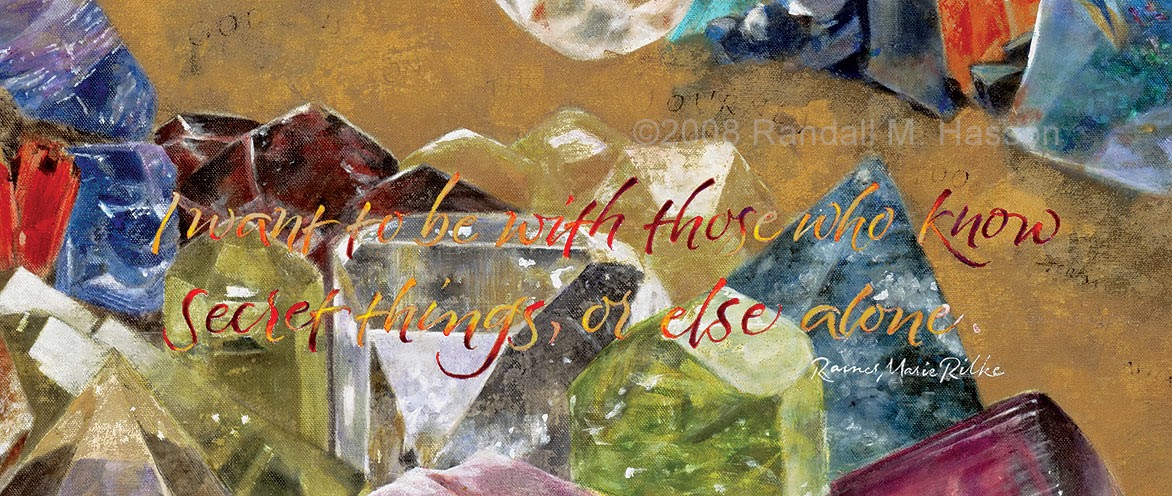
 "Forever" (detail) ©2008 Randall M. Hasson
"Forever" (detail) ©2008 Randall M. Hasson


(1). 1 Peter 3:15

Sunday, April 29, 2012

Commissioned painting: Thoughts on Angels and Light

Over the past couple of months, I have taken on a commissioned painting which takes an Angel as it's subject. This painting is large: just under 9' high and 6' wide.... large enough that I am painting it on-site. During in-depth interviews with the client and a couple of hundred pages of study on the subject, we came up with a direction and I had some imagery formulated in my head.

Angels, according to Judeo-Christian tradition, are messengers and beings of light. The word "angel" itself comes from the Greek and Hebrew words that mean "messenger". Through my studies, I came up with keywords that helped me characterize some visual qualities of Angels: light, fire and movement. In the Bible they have always been portrayed like men, while our visual heritage through centuries of painting shows them with wings. It is interesting to note that up until the forth century, angels weren't shown with wings, and then the first paintings show them with black or dark wings like birds.

For this painting, the client had a specific vision of an angel in action. One of her keywords for the painting was protection... a warrior angel protecting his charges and taking care of God's business. She was looking for the angel in a specific act... the Angel was going in one direction when suddenly it sees someone that needs help... the moment is of a change of direction in mid flight. This Angel was to have white wings.


The painting process is an interesting one, and working closely with a client on-site poses great opportunities for debate, stimulating conversation, brainstorming, and also opportunity for creative conflict.. After a couple of weeks, we had a discussion about the direction I was taking visually. At this point in the painting, what she was looking at and where I was going seemed to be two different emphases. I am attempting to create a painting of a being of light. Her desire is that I capture the intent of that specific moment. I realized that in this instance, she was reacting to what was on the canvas in front of her, while I was painting what I knew it was going to look like in a month. I could see the end result but she wasn't able to see where I was going.

Moments like this are defining moments in a project, and sometimes a career. She asked me to change what I was doing, and I was going to comply... it is her painting after all, on her wall, and she was paying me to create something for her. I was at a point where I was contemplating rolling up the canvas and starting over on a new one... one that I knew would be beautiful but that wouldn't have the magic I originally saw. I would just take this one back to the gallery and finish it there the way I knew it was 'supposed' to be.

I am fortunate to have a client however, that is sensitive and has seen enough of my work to have faith and trust in the process of the painting and the workings of the Spirit. She called me the next day and asked me to continue with my vision... she would trust that the outcome would be born of the Spirit. It was also an  excellent point within the painting process;   she was able to clarify for me that the intent of the figure was the key for her, but she realized that her vision would be different from mine.

Below are images of the progression of this canvas. With respect to the light rays, it is probably somewhere between 30% and 50% done... with the layering techniques I use, I expect the figure to be painted, then light painted through, and the figure again repainted. This has already happened a couple of times, and could occur multiple times as the process continues. The layers and light are important elements, and my goal is that as a viewer moves through the room, the reflective properties of the interference and pearlescent paints I am using will change and move with each step, both from within and without the figure. With the layering, the viewer will literally be looking through the glazes, making for depth in the movement of light as well.


The image that I am painting comes from my belief that if we were to see angels as they really were, spiritual beings, they would be a glittering and glorious sight to us that would leave us in awe, or fear and trembling. Since light is made up of all colors, this piece will have to have an array of color/light as well. Painting a subject like this leaves one to contemplate:  if Angels are said to be the lowest order of God's created beings, then they are merely a dim reflection of the glory of He who is actually "clothed in light".

Quite a thought to try and get one's brain around.


Monday, February 20, 2012

The beginnings of a trial version

Each time I do a painting, I usually have a strip of canvas where I can do trials of lettering. Most of the time with imagery I don't do a "real" comp but rather I just sketch and paint directly. In this case I  have that canvas strip, but I decided that I will do another complete painting that will act as a comp and where I can experiment, a  "small" canvas about half the size of the project. Here I have the 4' X 6' canvas laid on the floor on a tarp and am working out some painting techniques using a 10" drywall blade.


These strokes done in gold, white and  pale sienna will be repeated in layers and glazes over quite a few days with lettering and other imagery in between and there will be color washes throughout. They are abstracted to convey the feeling of movement. Later there will be various shades of gold powders mixed and applied in glazes as well. The final result should have the feelings of movement, fire, power, majesty, etc. The image of the angel will then be painted over this ground.


There is not much to decipher of this wrinkly canvas at this stage.  Because the canvas isn't on a frame or stretcher bars, it will go through various stages of buckling as the paint dries unevenly. It will eventually become flat again as the whole surface is covered. This is all part of the process... I am not looking at what is on the canvas today, I am looking at what will be there in 2 weeks. The most important aspect now is to establish that feeling of movement and power.

Saturday, February 18, 2012

Beginnings

I get pretty excited when I embark on a new painting. There is something wonderful and compelling about a blank, unprimed and unstretched canvas which cries out to an artist of it's need for the creative process to begin. I can feel it when I am there: there is an anticipation of that first mark, that first brushstroke, that beginning.

The new project is substantial, and I have a sense that it will be important.


The subject will be challenging and rewarding if I can manage to capture the feeling and convey it into the space... to allow the people who inhabit the space to get the sense of a presence there, or to be reminded of the unseen.


An interesting subject, Angels. Something I hadn't taken a large amount of time to study. They speak of protection and assurance that the message they carry is true. 

The image above was something that came fairly quickly... or as quickly as large letters can come while dipping a black bamboo carved pen into ink and attempting to lay down letters on raw canvas. One of my favorite times in a painting is this exploratory stage, trying things out on practice canvas to see how it translates. The table below the painting is ancient by today's standards... there is speculation that it may have been in the Notre Dame Cathedral at one time. I know not if this is true, but this image of the cross comes from the center. Like those who take rubbings of inscriptions, I laid the canvas down on the carved-relief cross and made a rough sketch. 

Beginnings are always interesting... the start of a new journey. I am looking forward to what is around the bend.

Saturday, February 20, 2010

The Shema: A journey into the realms of the Spirit

A little over a year ago, a friend asked me to do a painting for him that contained the "Shema", that most ancient Hebrew prayer: "Hear O Israel, the Lord our God, the Lord is One".

This small request was interesting because I do not read Hebrew, and up to this point hadn't written it either. In addition, it gave me the excuse to embark on a course of study that was to take me into the realms and the complexity of the Jewish Faith.

In the resulting paintings, the three parts of the Shema (Deuteronomy 6:4-9, Deuteronomy 11:13-21, and Numbers 15:37-41) are written in separate pages of Hebrew, then the two pages in the middle are translated in English. The main verses are layered over all of it...

(Click on the image to enlarge)

The word "Shema" means "listen" or "hear". One of the first books I read dealt with the meaning of  the "Shema" through the context of the various cultural stages in the long history of the Israelites. One of the most interesting observations of this book was that when Moses addressed the Israelites and asked them if they would accept and practice these tenets and precepts (this way of life), they replied
"We will do and we will hear".(1)
The order of the words is very important here; this form of "hearing" is by the experience of doing; the opposite of our idea in the western culture of "knowing why" before we choose to do something. In our culture we would say "we will hear" and then "we will do". There is an element of faith in the "doing" first and then coming to an understanding later through that process. (1)

I became more and more intrigued with the roots of this ancient prayer: This is the root of our Judeo-Christian culture of faith. I embarked on a three month long course of study which included books and writings about the origins of the Hebrew alphabet, the culture from which it was born, the mysticism associated with each letter, and the spirituality associated with each word which is made up by each of these individually significant letters, and the lessons that can be taken from what we take for granted to be "just words". *

Of course, I couldn't just stop at just one of these paintings. 

My good friend Izzy Pludwinski (2), the wise and accomplished calligrapher from Israel, was extermely patient with me in analyzing and helping me to learn to write the Hebrew text. I ended up doing a series of four paintings. One common visual theme among these paintings was that I wanted the representation of "pages" to have a couple of characteristics: I wanted them to be sort of "floating" (as through the mists of time), and I wanted them to look more ancient. I had a "dead sea scroll"(3) -type look in mind.

One of the series of paintings incorporated the gems which I had studied in a  recent, previous painting called "Forever". For that painting, I had researched many of the physical, metaphysical, mystical and spiritual beliefs centered around  various precious stones.
(Click on the image to enlarge)


In the painting above ("Shema 4"),  the stones in the middle represent the 12 tribes of Israel and are the stones of the breastplate of the High Priest; they also are the same stones represented as the Foundation Stones of the New Jerusalem spoken of in the New Testamant book of Revelation.

I also found that the number 13 is a significant number in Judiasm, being (among other things) the numerical value of the word ahava (love, Alef-He-Bet-He) and of echad (one, as in the Shema, G-d is One!, Alef-Chet-Dalet).  "Echad" is such a key word in the main part of the "Shema" (referring to the oneness of G-d), that placed behind the whole composition, and out of which the whole painting "springs forth", is the larger, crystal clear "13th stone".

In addition, there was room on Shema 4 to add more to the composition, and this was done by exerpting another verse, in background texture: "You shall teach them to your children, speaking of them when you sit in your house, when you walk by the way, when you lie down, and when you rise up"(4). I just happened to like the lyricism and the rhythm of these words that, to me, speak of parenting and direction; a passing on of a sacred tradition.

I find that paintings like this are the most intriguing to me... they are a challenge on a multiplicity of levels. I love to do paintings that contain significant themes, and this one certainly opened new vistas of insight and thought for me.

I look forward to the next journey.

*More information on these paintings, including the books used in reference and larger detail images, can be found at either of these links:
http://www.randallmhasson.com/Sh'ma.htm
http://www.randallmhasson.com/sh_ma_4.htm


(1)  Witnesses to the One: The Spiritual History of the Sh'ma ~ 2006 Rabbi Joseph B. Meszler; Jewish Lights Publishing
(2) Izzy teaches correspondence course in Hebrew Calligraphy, and is a sought after artist. His website is: http://www.impwriter.com/
(3) note: the Dead Sea Scrolls had a more ancient Hebrew style of text; I opted for a more readable version of text for the current viewer of the painting.
(4) Deuteronomy 11:19 (NKJV)

Saturday, October 3, 2009

Journal Series: Brennan Manning's "The Ragamuffin Gospel" page

There is a time I think, in all of our lives that we go thru a spiritual crisis or questioning phase... whether you have a "faith" or have rejected one (or many).

There comes a point where you think you have "heard it all before" or, more apporpriately, it just doesn't seem "fresh" anymore. At the time I began this journal, I was in that place. My brother came along one day and as we were discussing this, he mentioned that I should read Brennan Manning. I said "who is he?", and he replied that Brennan Manning is an alcoholic-married-catholic-priest who writes about Grace.

Well that kinda hooked me. He had a copy of the "Ragamuffin Gospel" by Manning that I promptly stole.

(Click image to enlarge)

Manning is one of those writers who came along at the right time for me. He is an Irishman who has that lilting cadence and his writing style is as if he is speaking to you not composing a sentence. Here in this period of my life, this was a pivot-point; I was undergoing a paradigm shift spiritually. Through his writings, my view of my personal and loving God changed and gave me something extremely valuable: Freedom in my faith.

We are encouraged spiritually to "live in the Light", while reality dictates that this is a difficult proposition. The page illustrated above highlights a passage from Manning's book about paradoxes...

"I am a bundle of paradoxes. I believe and I doubt, I hope and I get discouraged, I love and I hate, I feel bad about feeling good, I feel guilty about not feeling guilty, I am trusting and suspicious, I am honest and still play games. Aristotle said I am a rational animal, I say I am an angel with an incredible capacity for beer! To live in Grace means to acknowledge my whole life's story, the light side and the dark. In admitting my shadow side, I learn who I am and what God's Grace means. As Thomas Merton said, "A saint is not someone who is good but who experiences God's goodness". "

The page above is a simple visual illustration of the paradoxical concept. The page immediately preceeding this one dealt with the "be transformed by the renewing of your mind" concept. So, on this page spread, I have illustrated the "light" from that previous page and also a shadowy area as well. As a visual paradox, the text is back in the "boxes" that we have just "broken out of" in the three previous page spreads. Also, I didn't want to write these words in "calligraphy', preferring simply to write them... the act of writing words like this causes me to "apprehend" them more than just reading them.

I am not a big seminar goer, but later I was to attend a weekend series to hear Brennan Manning speak. My notes were in written in a journal spontaneously and will be discussed in a later series...